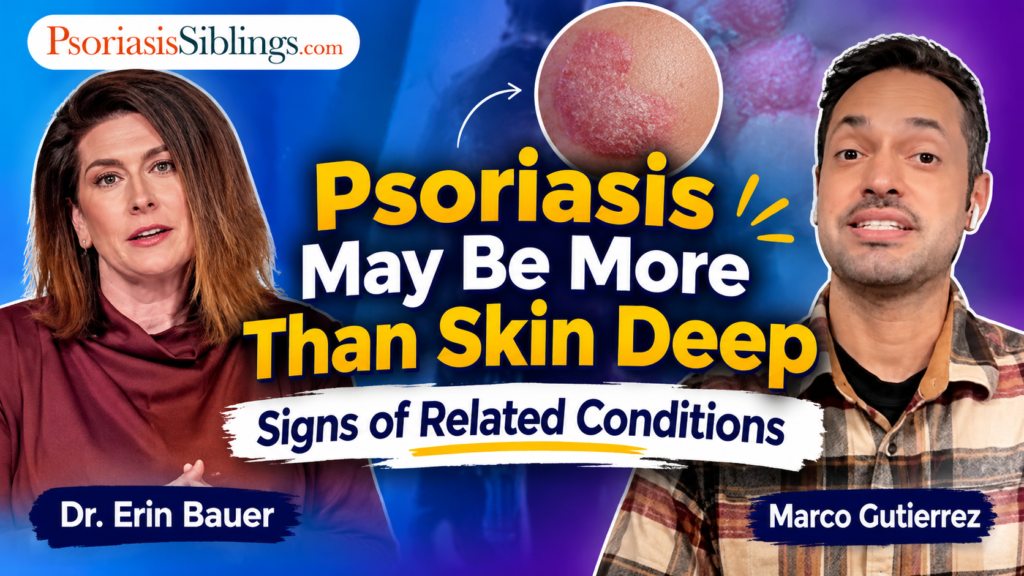

For the millions of people living with plaque psoriasis, what shows up on the skin may be a signal of chronic inflammation happening deeper inside the body. This week on Coast to Coast with Heather Dawson, we’re taking a closer look at a group of connected autoimmune conditions known as “Psoria-Siblings”—and why recognizing early symptoms is so important.
Joining us on behalf of Johnson & Johnson is Dr. Aaron Bauer, a rheumatologist at Virginia Mason Medical Center. Dr. Bauer explains that “Psoria-Siblings” highlights how plaque psoriasis shares similar inflammatory pathways with psoriatic arthritis (an autoimmune joint disease) and inflammatory bowel disease (IBD) (intestinal inflammation). In fact, about 30% of people with plaque psoriasis may go on to develop psoriatic arthritis, while up to half can experience some level of intestinal inflammation.
Because many people living with psoriasis aren’t aware of these links, knowing what to watch for can make a major difference. According to Dr. Bauer, a key risk factor for developing psoriatic arthritis is having psoriasis on the scalp or fingernails—such as small pitting in the nails or the nail lifting off the bed—especially if paired with joint pain, swelling, or inflammation. On the digestive side, symptoms can be subtle, but ongoing abdominal discomfort or blood in the stool are clear signs that you should be evaluated for inflammatory bowel disease.
Leaving these related inflammatory conditions untreated can carry serious long-term risks, making early detection and open conversations with your doctor essential. To learn more about the symptoms and risks of Psoria-Siblings, visit psoriasiblings.com.
Also on Coast to Coast
-
Meaningful Holiday Jewelry Gifts with Heart: The Honest Jeweler & Shaneli x Cancer Culture
-
What Men Over 40 Tell Their Matchmaker—And What They’ll Never Say on a Date!
-
Summer of Serenity: Reset, Recharge & Reconnect
-
Coast to Coast with Heather Dawson — Episode 143: Around the World & Full Throttle
-
Coast to Coast with Heather Dawson — Episode 142: Ireland, Iconic Voices & Viral Surprises