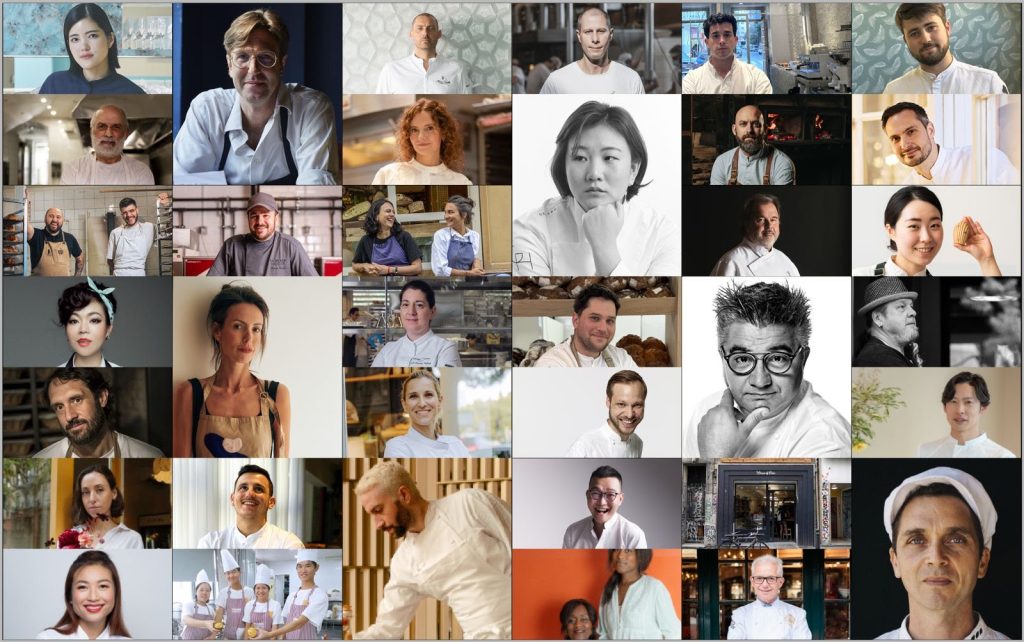

● From K-Pop to K-Pastry: For the first time, the World’s Most Creative Pastry Chef Award goes to Korean pastry chef Eunyoung Yun follows in the footsteps of Amaury Guichon, Bastien Blanc-Tailleur, and Maxime Frédéric, reflecting the growing influence of Asia on the global pastry scene. Overall, women represent nearly one-third of the 2026 award winners, with 11 female chefs recognized.
● The Rise of Bread Culture: La Liste shines a spotlight on a new generation of artisan bakers and
sourdough pioneers, with 12 bakery-focused awardees. From Richard Hart, the “sourdough whisperer,”
to Thomas Teffri-Chambelland, a pioneer of gluten-free bread in France, as well as Mamiche in Paris,
Joseph Brot in Vienna, and O’Mills Bakery in Shanghai, bread has firmly reclaimed center stage.
● Game Changer Award: American chef Will Goldfarb, based in Ubud, Bali, receives the Game Changer
Award for redefining contemporary dessert through Indonesian sourcing, regenerative thinking, and a
singular vision that has made him one of the most quietly influential figures in modern gastronomy.
● French pastry’s enduring global influence: Several French laureates exemplify the cultural heritage,
creativity, and international reach of French pastry. Frédéric Bau receives the Pastry Impact Award for
his lasting contribution to the profession, while Marius Dufay is recognized with the World’s Best
Afternoon Tea Award. Michael Bartocetti’s seasonal creations at Four Seasons Hotel George V Paris further showcase French pastry excellence, while Maison Pierre Hermé Paris receives the World’s Best
Pastry Shop Award, confirming the continued global influence of one of France’s most iconic pastry
houses.
● A truly global selection: The 2026 Pastry Special Awards feature 12 categories—from Talent of the
Year and Best Opening to Innovator, Artisan, and Hidden Gem—recognizing 36 winners from 18
countries across Europe, Asia, North America, and the Middle East.
● 18 countries represented: France, United Kingdom, Italy, Spain, Portugal, Switzerland, Austria,
Denmark, South Korea, Indonesia, Malaysia, Singapore, China, Japan, Australia, United States, Mexico,
and the United Arab Emirates.
LA LISTE, a global and curated gastronomic guide, the only one highlighting pastry talents
LA LISTE selects, ranks, and celebrates the world’s best restaurants, hotels, and pastry shops, while
championing culinary diversity. Positioned as the digital reference for global gastronomic travel, the guide
offers both curated content and data-driven rankings. Its methodology, inspired by artificial intelligence,
aggregates over 1,000 trusted culinary sources. The restaurant and hotel rankings are algorithm-based, while special awards reflect a deliberately eclectic editorial perspective.
LA LISTE’s commitment to pastry
LA LISTE’s selection of the World’s Best Pastry & Bakery Shop Selection is a unique project, now listing over 3,000 establishments worldwide—including pâtisseries, bakery-cafés, dessert restaurants, and tearooms—available through the LA LISTE mobile app alongside its restaurant and hotel listings. The platform also expands its annual Garden Party program with the International Pastry Forum, a conference on global trends led by industry pioneers and organized in collaboration with Pierre Hermé, recipient of LA LISTE’s 2023 Award of Honor.
Philippe Faure, Founder and President of la Liste says “Since its creation, LA LISTE has pursued a simple
ambition: to offer a global and balanced perspective on excellence. In a world where opinions are increasingly fragmented, we believe that consensus remains valuable. By bringing together the judgments of guidebooks, critics, specialists and diners from around the world, LA LISTE provides a unique international reference point while respecting the diversity of culinary cultures.”
LA LISTE PASTRY SPECIAL AWARDS 2026
WORLD’S MOST CREATIVE PASTRY CHEF AWARD sponsored by Cacao Barry
A pastry chef demonstrating extraordinary creativity, whose technical skill pushes the craft of pastry into
an art form
GARUHARU – Chef Eunyoung Yun – Seoul, South Korea
PASTRY IMPACT AWARD
A chef whose inspiring career is marked by bold reinvention and continuous growth with a lasting
influence on the global pastry scene.
FRÉDÉRIC BAU – France
WORLD’S BEST AFTERNOON TEA AWARD sponsored by Palais des Thés
Exemplary afternoon tea experience, whether traditional or contemporary concept, with outstanding
service and location
JACQUELINE AT THE CHANCERY ROSEWOOD – Marius Dufay – London, England
FOUR SEASONS HOTEL GEORGE V – Michael Bartocetti – Paris, France
WORLD’S BEST PASTRY SHOP AWARD
Breakthrough concept from a pastry shop or group in terms of products, design, and customer experience
PIERRE HERMÉ PARIS – Sentosa, Singapore
PASTRY GAME CHANGER AWARD
An exceptional pastry chef who has developed to change pastry in discrete and culture through
innovation, commitment, and education.
WILL GOLDFARB – Room 4 Dessert, Bali, Indonesia
BAKERY INNOVATION AWARD sponsored by BWT Diamond Mineralized Water
Bakery chefs redefining their craft through creativity and innovation
RICHARD HART – Hart Bageri Copenhagen, Denmark – Claridge’s Bakery, London, UK
THOMAS TEFFRI-CHAMBELLAND – Ecole Internationale de Boulangerie, Noyers sur Jabron –
Chambelland, Paris – La Fabrique à pain, Aix en Provence – Maison Deschamps, Lyon – France
PASTRY ARTISAN & AUTHENTICITY AWARD
Pastry shops promoting the culinary heritage of a region or country through technique, creativity, and
sourcing
MAISON BONNAT – Stéphane Bonnat – Paris, France
CAFFÈ SICILIA – Corrado Assenza – Noto, Italy
PASTRY ETHICAL & SUSTAINABILITY AWARD, sponsored by BWT Diamond Mineralized
Water
A bakery or pastry shop(s) demonstrating exemplary dedication to ethical practices, sustainability and
social responsibility within the workplace, industry and wider community
MAMICHE – Cécile Khayat & Victoria Effantin – Paris, France
JOSEPH BROT – Josef Weghaupt – Vienna, Austria
PASTRY COMMUNITY SPIRIT AWARD
Project led by a chef, restaurateur or organization that supports their community or a cause.
SHANGHAI YOUNG BAKERS – Shanghai, China
PASTRY & BAKERY OPENING OF THE YEAR AWARD sponsored by Silikomart
Impressive newcomers to the pastry & bakery scene that deserve recognition
LE CAFÉ BY NICOLAS ROUZAUD – Nicolas Rouzaud – London, England
MAISON DEVOILLE – Christophe Devoille – Dubai, United Arab Emirates
BLUE BOX CAFÉ by Natsuko Shoji – Tokyo, Japan
Zoom France
L’OKARA – Linda Vongdara – Brunoy, France
PÂTISSERIE TOSHIYA TAKATSUKA – Toshiya Takatsuka – Paris, France
LE SALON DE THÉ, LE CHAMBARD – Olivier Nasti & Jordan Gasco – Kaysersberg, France
DU PAIN ET DES MIETTES – Julien Allano & David Andria – Bonnieux, France
THOMAS DURA PÂTISSERIE – Thomas Dura – Écully, France
PASTRY TALENT OF THE YEAR AWARD
Most promising pastry chefs of the year (across pastry shops, bakeries, tea rooms, and dessert
restaurants)
HYOJU PARK – Madeleine de Proust – Melbourne, Australia
JULIANA PENTEADO – Juliana Penteado Pastry – Lisbon, Portugal
JEFFREY TAN – JT Pâtisserie by Jeffrey Tan – Penang, Malaysia
MIGUEL YESTE – Obrar Madrid – Madrid, Spain
MARCELO MABILIA – Manufactures Alain Ducasse – Paris, France
PASTRY DISCOVERY GEM AWARD
Off-map uprising gem, little-known or hard-to-find pâtisseries, bakeries, afternoon teas, or dessert
restaurants worth going the extra mile for.
FROM LUCIE – Lucie Franc de Ferrière – New York City, United States of America
PANADERIA ROSETTA – Elena Reygadas – Mexico City, Mexico
BURNT ENDS BAKERY – Dave Pynt – Singapore
EIGENBRÖTLER BACKWERKE – Daniel Amrein – Wauwil, Switzerland
O’MILLS BAKERY & BISTRO – Xiao Xiao – Shanghai, China
Zoom France
LOISEAU LA PÂTISSERIE – Lucile Vigilant – Saulieu, bientôt Metz & Megève, France
LÉA CHIARI PÂTISSERIE – Léa Chiari – Nîmes, France
GONFLÉ BOULANGERIE – Timothy Breton – Paris, France
HOUSE OF PAIN – Pierre Houlès & Jérôme Flayac – Marseille, France
MANDIPILI – Aimée & Anne-Sophie Mendy – Paris, France
GLOBAL PASTRY AND BAKERY TRENDS
How globalization, algorithms, and a revival of bread are reshaping the future of pastry and bakeries.
The global pastry sector has undergone a radical structural transformation over the last years. While
classic French technique – the absolute mastery of lamination, emulsification, and baking – remains the
non-negotiable foundation, the industry is currently walking a tightrope between two opposing forces.
On one side is a highly refined, cross-cultural maturation of the craft; on the other is the superficial
pressure of a digital attention economy and a systemic retreat from original creativity
- The Great Gastronomic Paradox: Borderless Pastry, Rooted Bread
- The most profound shift in the modern culinary landscape is an existential split between the sweet and the savory. While the restaurant world has spent the last decade turning inward- retreating into hyper-localism, celebrating terroir, and cementing regional identities- pastry has broken free from geography entirely. Curiously, bread has moved in the opposite direction. As pâtisserie becomes increasingly global, artisanal bread is becoming increasingly local, tied to grain varieties, milling traditions, fermentation cultures, and agricultural identity.
- Pastry trends now spread worldwide in a matter of weeks, unburdened by the soil. A Korean restaurant cannot resemble a French restaurant because its very soul is tied to the specific identity of its regional ingredients and history. Yet, a croissant in Seoul can easily look, feel, and taste exactly like one in Paris. Pâtisserie may be the first premium culinary language to become genuinely borderless.
- The French-Asian Symbiosis: Maturation Over Novelty
- What began as a niche movement has matured into a defining creative constant of this globalized era. The fusion of French pastry craftsmanship with East Asian flavor profiles (primarily from Japan, South Korea, Thailand and China) is not a superficial garnish; it is a profound structural reform of classic recipes. Driven by exceptionally trained Asian chefs who have mastered the rigors of the French school, we are witnessing a long-overdue departure from heavy, European sugar densities. Matcha, yuzu, roasted black sesame, and miso are not used for shock value, but to elegantly cut through the richness of buttercreams and laminated doughs using bitterness, acidity, or umami. The Asian aesthetic often demands a more restrained sweetness and airier textures. The result can be a more purist, balanced pastry that respects the intrinsic flavor of the raw ingredients.
- The Middle Eastern Export: From Pistachio to Kadaïf
- For generations, culinary influence was a one-way street: France exported technique, and the rest of the world politely adopted it. Today, the Middle East is fundamentally reversing this dynamic, exporting its own rich flavor heritage and structural elements straight into the heart of Western baking. One of the clearest examples can be found at Lam in Paris, led by Saudi chef Abdulatif Alrashoudi, where impeccable French execution serves as a canvas to express authentic Middle Eastern flavor profiles with extreme precision. Pastry chefs have increasingly integrated orange blossom (fleur d’oranger), sumac, kadaïf, and sesame-based ingredients such as tahini into traditional tarts and mille- feuilles, sometimes completely replacing classic vanilla and berry pairings. Concurrently, on a macro level, pistachio increasingly plays the role vanilla once occupied in luxury pastry. Driven to a frenzy by the viral “Dubai chocolate” phenomenon (which triggered a global stampede for khadaifdough), high-grade pistachio paste and toasted khadaif have transcended their regional roots. Pâtissiers from London to Tokyo are now using buttery, toasted khadaif inside chocolate fillings, tart bases, and praline layers simply to achieve an intense, authentic textural crunch that industrial food science cannot easily replicate. Pistachio is no longer an alternative flavor; it is the almost mandatory green gold required to signal modern luxury.
- The Visual Mirage: Where Technique Meets the Lab
- The trendy claim that “texture is the new flavor” has fueled a massive demand for extreme physical contrasts – molten centers, hyper-crispy layers, and viral phenomena like kataifi-stuffed chocolates and tarts. However, a line must be drawn between the artisan who achieves this through precise temperature control and the commercial operator who relies on a secret cabinet of helpers. Much like chefs de cuisine who publicly preach the gospel of local sourcing while privately leaning on texturizers behind closed doors, a segment of the pastry world has quietly embraced food chemistry to keep up with social networks. To achieve the flawless mirror glazes, vibrant neon hues, and unnaturally prolonged crunch demanded by algorithms, traditional craftsmanship is often supplemented. In these specific hyper-visual concepts, the consumer is sometimes trading genuine flavor for industrially engineered stabilizers, modified starches, artificial colorants and liquid flavors, hidden carefully out of sight. The economics of digital visibility increasingly reward visual impact over gustatory complexity.
- The New Wave Boulangerie: Bread, Sourdough and Cultural Prestige
- If pâtisserie has become the first premium culinary language without borders, bread has followed a remarkably different trajectory. Across Europe, North America, Japan and parts of Asia, artisanal baking has undergone a profound cultural revaluation. Twenty-five years ago, organic grains, stone milling, heritage wheats and natural fermentation were often associated with alternative lifestyles and niche enthusiasts. Today, they occupy the highest levels of culinary prestige. Great bakers have become cultural figures, and exceptional bread has become a luxury product in its own right. Artisanal loaves that would once have been considered humble staples now comfortably command prices of $10 per kilo or more, and bread itself has become a gastronomic object. In a growing number of restaurants
(including JAN in Munich) it is served not merely as an accompaniment but as a dedicated course. If pastry has become the most globalized expression of baking culture, bread may have become its most local.
Beneath the cultural renaissance lies a simple economic reality. Bread remains one of the most
profitable products in the shop. While butter-rich viennoiseries and elaborate pastries are vulnerable to volatile ingredient costs and labor intensity, a well-made sourdough loaf often combines strong margins with growing consumer demand. The cultural rehabilitation of bread has been accompanied by an equally dramatic revival of sourdough fermentation which has spread into the pastry sector. The expansion of sourdough (levain) into sweet pastry reflects both a genuine technical revival and a powerful marketing opportunity. While long fermentation can contribute a beautiful complexity of flavor and may improve digestibility, the health claims surrounding sourdough pastry often deserve closer scrutiny. A croissant remains fundamentally a rich product made from flour, butter, and sugar, regardless of the fermentation method employed. The marketing machinery, however, is remarkably adept at transforming a luxury pastry into a wellness narrative simply because a wild lactobacillus spent twelve hours looking at the dough.
- If pâtisserie has become the first premium culinary language without borders, bread has followed a remarkably different trajectory. Across Europe, North America, Japan and parts of Asia, artisanal baking has undergone a profound cultural revaluation. Twenty-five years ago, organic grains, stone milling, heritage wheats and natural fermentation were often associated with alternative lifestyles and niche enthusiasts. Today, they occupy the highest levels of culinary prestige. Great bakers have become cultural figures, and exceptional bread has become a luxury product in its own right. Artisanal loaves that would once have been considered humble staples now comfortably command prices of $10 per kilo or more, and bread itself has become a gastronomic object. In a growing number of restaurants
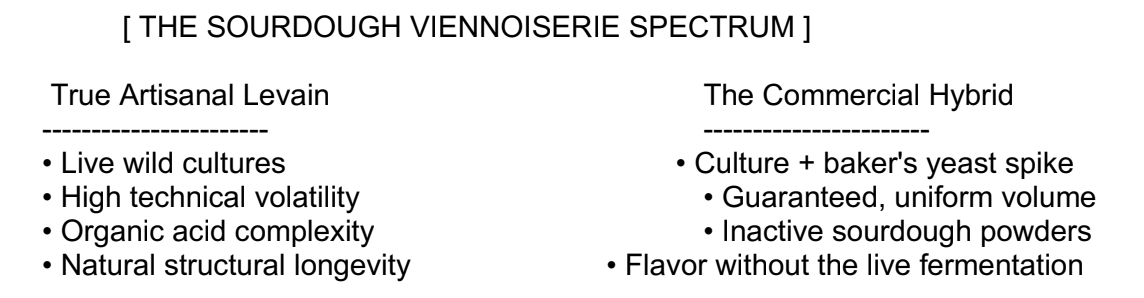
However, a distinction must be made between the pure, natural fermentation of this new-wave baking
and the industry’s hybrid adaptations. Sourdough viennoiserie and sourdough breadmaking are
increasingly operating as two entirely distinct disciplines. Many commercial bakeries employ hybrid
systems combining sourdough cultures with baker’s yeast to ensure consistency and production
efficiency. In industrial settings, dried or inactive sourdough preparations are also used as a clever
shortcut to provide that coveted artisanal flavor and acidity without any of the operational constraints
of live fermentation.
6. The Single-Product Monoculture vs. The All-Day Hybrid
The structural layout of our culinary capitals is experiencing a severe split. On one side stands the
hyper-specialized boutique focusing radically on a single category (only flans, only madeleines, or
premium croissants) as a calculated shield against exploding commercial rents, raw material costs,
and skilled labor shortages. It is an economic model built entirely on maximum standardization and
razor-sharp digital marketing.
But where capital and hospitality investment are abundant, a powerful alternative model has emerged:
The All-Day Hybrid Space. In direct opposition to the single-product shop, the lines between pastry,
baking, coffee culture, and casual dining have completely dissolved. We are seeing the rapid rise of
premium, fluid third-places where consumers can buy bread, experience high-end pastry, drink
specialty coffee, or enjoy a sophisticated snack at any hour of the day. Pierre Hermé’s new flagship
boutique in Singapore perfectly encapsulates this model, serving as a global blueprint for a luxury
brand morphing into an all-day, experiential hybrid space.
A related development can be observed in luxury hospitality. The traditional Afternoon Tea has
evolved from a simple social ritual into a sophisticated, sequenced gastronomic experience. In many
leading hotels, pastry creativity now flourishes in curated multi-course tea menus that are largely
protected from the economic constraints of high-street retail. Here, complexity, storytelling, and plated
presentation continue to thrive.
- The “Hollywoodization” of Pastry
Beyond flavors, textures, and business models, the most definitive trend of our time is not a trend of
products at all – it is a macro-trend of culture. The pastry world has traded conceptual creativity for
hyper-optimization.
When we compare today’s landscape to the time period roughly between 1990 and 2015, the contrast
is stark. During this period, spearheaded by icons such as Pierre Hermé, Sadaharu Aoki, Christophe
Michalak, Jordi Roca, Oriol Balaguer and Paco Torreblanca, there was an insatiable desire to invent
entirely new dessert architectures. They questioned the very anatomy of an entremet, shattered
structural boundaries, and built new culinary concepts from the ground up.

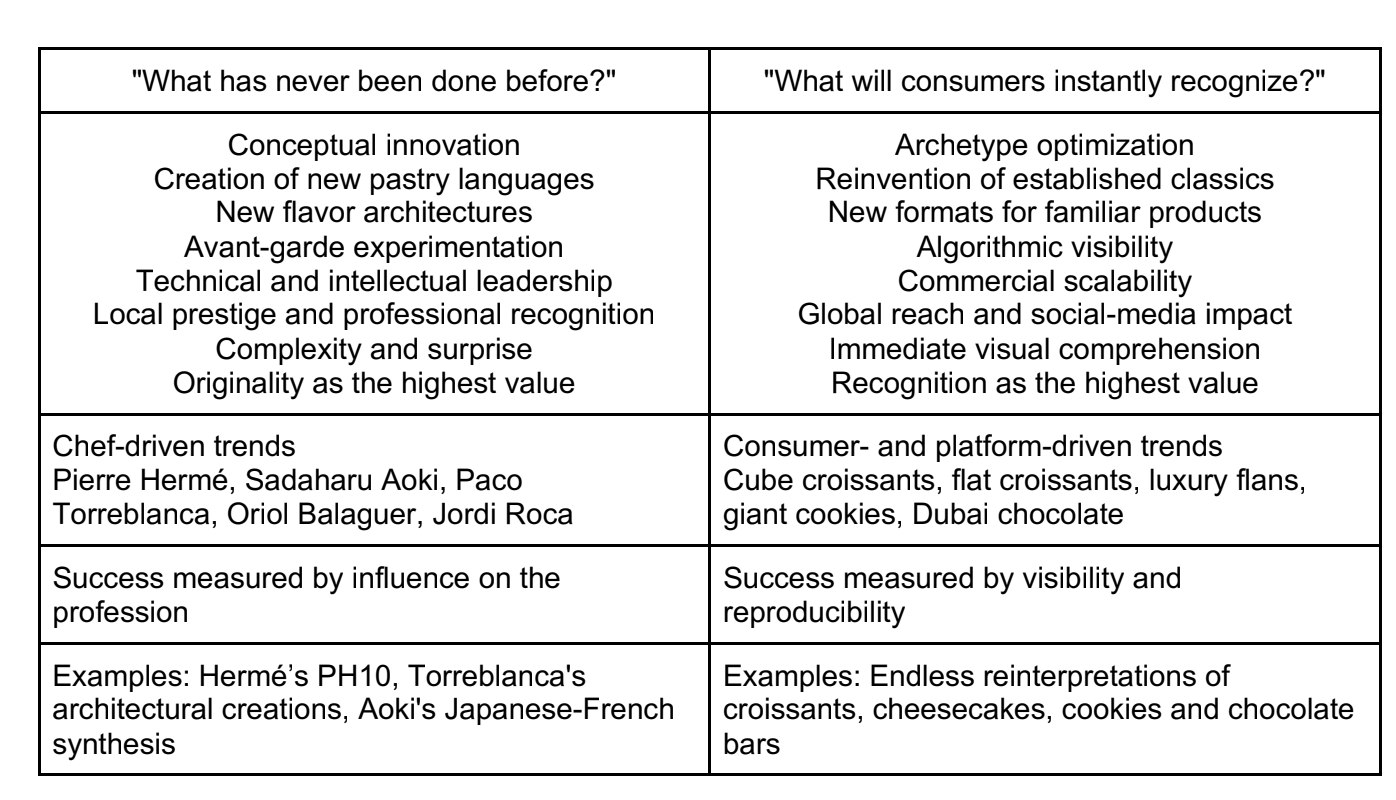
Today, such avant-garde conceptual bravery has become less common. In its place, the global market
is experiencing the exact same phenomenon as Hollywood: less genuine invention, more optimization
of proven, collective cultural archetypes. This dynamic directly mirrors the economic logic of our
borderless marketplace: Globalization rewards standardization. Standardization rewards recognizable
products. Recognizable products reward optimization over invention. The paradox is that the same
globalization that allows a croissant to travel effortlessly across continents may also make it harder for
entirely new pastry languages to emerge.
Because traditional, well-known desserts belong to everyone and carry less financial risk, they have
become the ultimate industry currency. Instead of inventing the next boundary-breaking dessert shape
or concept, the industry is locked in an endless loop of tweaking familiar, universally recognized
objects. We are trapped in a cycle of re-engineering the croissant (flattening it, cubing it, rolling it),
elevating the flan, maximizing the cheesecake, stuffing the madeleine, upgrading the cookie, and
riding the wave of the Dubai chocolate bar.
This is the ultimate intersection of globalization and social media. In a borderless market, the safest
product to scale globally is rarely the most original one; it is the archetype the consumer already
recognizes. The result is a subtle but profound transformation of creativity itself. Innovation
increasingly consists not of inventing new forms, but of endlessly refining familiar ones. By
modernizing and monetizing the familiar, the global pastry sector has achieved unprecedented
commercial efficiency and worldwide reach—but it has done so by trading part of its revolutionary
spirit for a masterfully executed, beautifully glazed remake.
Yet the very forces that reward imitation may eventually create demand for genuine originality. Every
movement has a counter-movement; every era of optimization ultimately creates its own rebellion. And
if we look at pastry historically—from Antonin Carême to Pierre Hermé—the breakthroughs almost
always emerged when everyone thought the rules had already been settled.
The future may therefore belong not to those who perfect the next croissant variation, but to those who
once again dare to imagine a new pastry language altogether.
The great question for the coming decade is whether that language will emerge from a pastry chef, a
country or culture, or an algorithm.
GARDEN PARTY
LA LISTE INTERNATIONAL PASTRY FORUM 2026
The La Liste International Pastry Forum brings together winners of the Pastry Special Awards for an
inspiring hour of discussion dedicated to the major trends shaping the global pastry and bakery
landscape. Through personal insights, professional experiences, and dynamic exchanges, participants
offer a unique perspective on the evolution of the sector.
The 2026 edition will explore three key themes:
● French pastry, a living heritage with global influence, with Pierre Hermé, Frédéric Bau, Loïc
Bienassis and Mathieu La Fay;
● Will Goldfarb’s pioneering vision that “Dessert deserves the full weight of a meal,” through an
immersive journey into the world of Room4Desserts in Ubud, Bali;
● The revival of artisan breadmaking with “Bread Culture: Sourdough, Craftsmanship and the
New Generation of Bakers,” introduced by La Liste Editor-in-Chief Jörg Zipprick, who will present
an overview of global bakery trends before a conversation with Thomas Teffri-Chambelland and
Victoria Effantin and Cécile Khayat, founders of mamiche.
COCKTAIL RECEPTION
The La Liste Garden Party brings together the worlds of pastry, gastronomy, and hospitality for an
unforgettable summer evening in the enchanting and exclusive setting of the Jardins du Gouverneur
des Invalides in Paris.
Designed as a celebration of culinary creativity and conviviality, the event combines a festive
atmosphere with an exceptional feast of both savory and sweet creations prepared by some of the
most exciting talents on today’s gastronomic scene.
On the savory side, guests will enjoy specialties from an outstanding line-up of chefs, including Emeline
Aubry, finalist of the World Pâté en Croûte Championship; Danny Khezzar, recipient of the La Liste
Talent of the Year Award 2026, offering a preview of his acclaimed street-food concept Sheesh, soon
to open in Paris; Alice Tuyet and the Daimant Collective team showcasing their innovative plant-based
cuisine; Albane Auvray and Hugo Rigoulet from Groot La Tourte; and Alessandra Montagne from
Nosso, serving her signature Brazilian Beijinho elevated with truffle and caviar.
The sweet buffet will feature creations from some of the most celebrated names in pastry, including
Maison Pierre Hermé Paris, Alexis Beaufils, Dej Kewkacha—presenting in Paris for the first time his
Thai-inspired French pastries from Thailand—Sachi Takagi, former La Liste Pastry Award laureate from
RAU Kyoto and founder of the soon-to-open Keula Paris, and David Alves, Meilleur Ouvrier de France
Glacier.
MARK YOUR CALENDAR
LA LISTE, founded in 2015 by its current President Philippe Faure, continues its international expansion as a unifying force within the chef community and the only organization to offer a global digital guide with such a diverse and inclusive selection of restaurants, pastry shops, and hotels.
LA LISTE will host its annual gala ceremony, unveiling the Top 1,000 World’s Best Restaurants and the 2027
Special Awards, scheduled for Monday, November 23, 2026, in Paris.
Also on Coast to Coast
-
Minor Hotels to Launch Australia’s Largest Integrated Resort Wellness Precinct at Avani Cypress Lakes
-
Allegretto Vineyard Resort Brings Holiday Magic and New Family Traditions to Paso Robles
-
Pacific Park Honors Dolly Parton With Special Pink Ferris Wheel Tribute
-
Grassroots Petition Launches to Honor Dolly Parton’s Legacy in Nashville Reaches Over 100,000 Signatures
-
Coast to Coast with Heather Dawson — Episode 144